🔄 Rebranding NAFLD to MASLD: Why the Nomenclature Change Matters
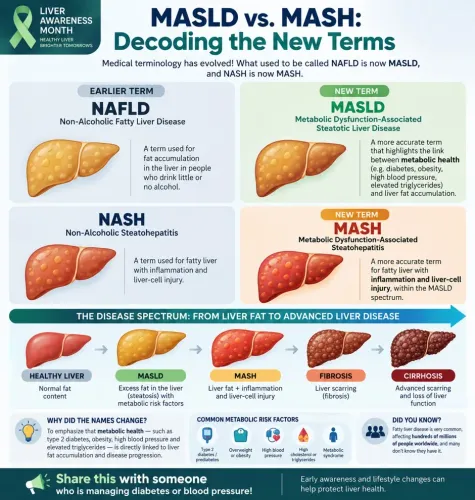
In recent years, the global hepatology community achieved a monumental consensus milestone: officially retiring the legacy term "NAFLD" (Non-Alcoholic Fatty Liver Disease) and transitioning to MASLD (Metabolic Dysfunction-Associated Steatotic Liver Disease).
This is far more than an exercise in medical semantics. For clinical practitioners, researchers, and public health advocates, this nomenclature shift fundamentally transforms how we diagnose, discuss, and de-stigmatize liver disease.
Here is why this diagnostic evolution matters for our daily practice:
❌ 1. Eliminating the Stigma of Exclusion
The historic term "Non-Alcoholic" inherently defined a disease by what it wasn't, rather than what it was. More importantly, it frequently introduced unintended stigma, forcing patients into defensive conversations regarding alcohol consumption. By shifting to "Steatotic Liver Disease" (SLD) as the umbrella term, we establish a neutral, anatomically accurate, and non-judgmental diagnostic baseline.
🧬 2. Centering the True Pathophysiology
MASLD explicitly embeds the root cause of the condition into the diagnosis itself: metabolic dysfunction.
To meet the clinical criteria for MASLD, a patient must present with hepatic steatosis alongside at least one of five cardiometabolic risk factors:
• Overweight / Obesity (BMI or waist circumference thresholds)
• Pre-diabetes or Type 2 Diabetes Mellitus
• Hypertension (or active antihypertensive treatment)
• Hypertriglyceridemia (or active lipid-lowering therapy)
• Low HDL-cholesterol levels
This structural change allows us to treat the liver not as an isolated organ, but as a central player in a patient's broader metabolic and cardiovascular health profile.
🤝 3. Fostering Multi-Disciplinary Patient Care
Because the diagnostic criteria for MASLD are now directly intertwined with metabolic markers, the new nomenclature builds a natural bridge between medical specialties. It encourages early, proactive triaging and co-management pathways between Gastroenterologists, Hepatologists, Diabetologists, Endocrinologists, and Primary Care Physicians.
🔬 4. Clarifying the Progression: MASH
Parallel to this change, NASH (Non-Alcoholic Steatohepatitis) has transitioned to MASH (Metabolic Dysfunction-Associated Steatohepatitis). This clearly denotes the stage where fat accumulation has triggered active inflammatory cellular injury and progressive fibrosis, providing a cleaner clinical framework for tracking disease evolution and assessing therapeutic endpoints in clinical trials.
🩺 Professional Perspective
Adopting MASLD/MASH in our clinics, discharge summaries, and medical writing is an impactful step toward improving patient understanding and compliance. When patients realize their liver health is directly tied to actionable metabolic metrics, it shifts the narrative from passive observation to proactive lifestyle and therapeutic intervention.
Let's lead the transition in our medical communities.
Keywords