Chicago Classification of Achalasia: Diagnostic Subtypes & Tailored Treatment Pathways
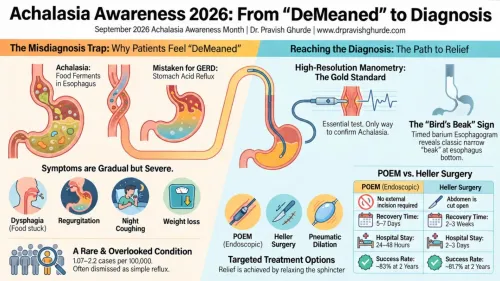
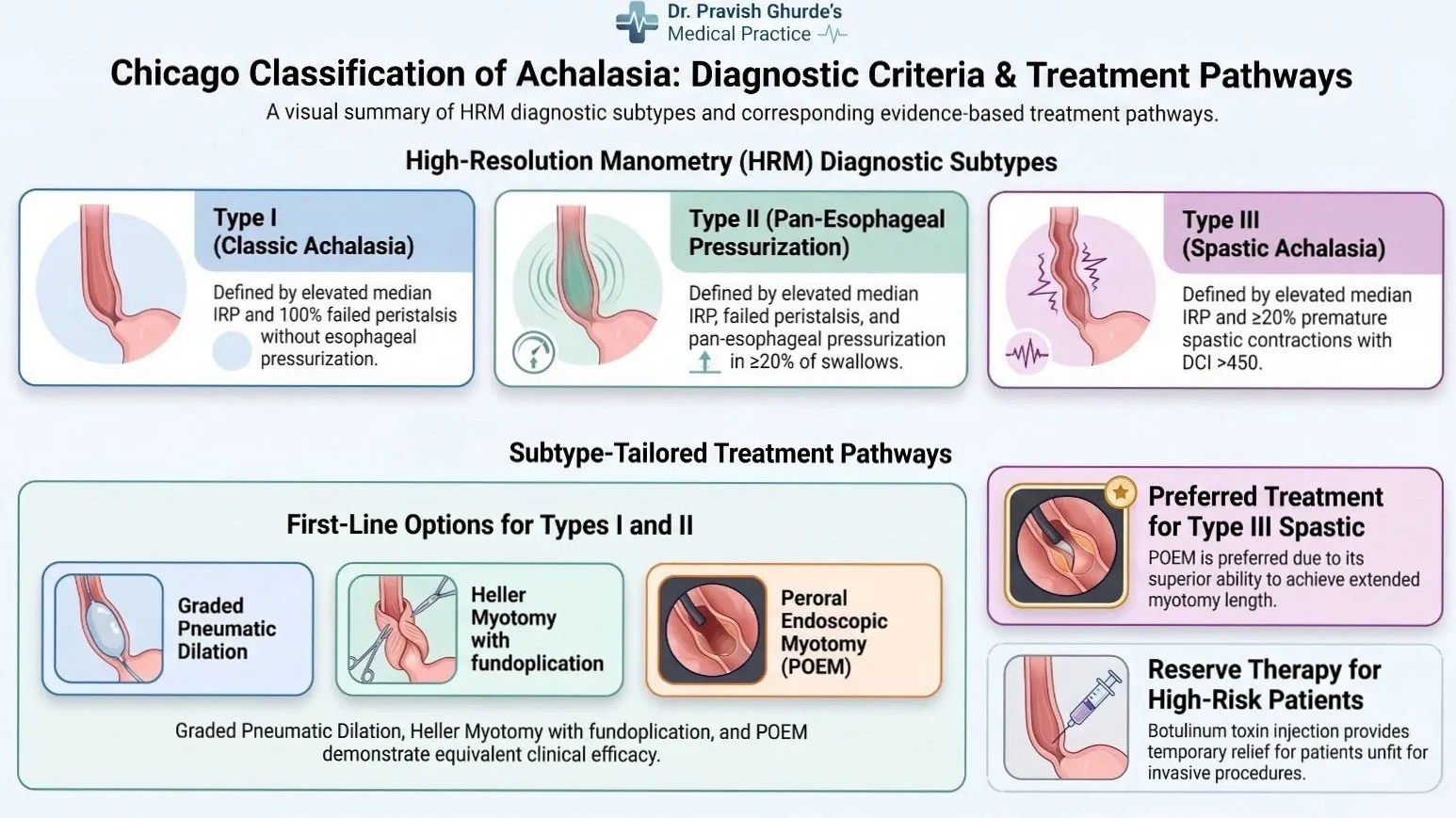
Achalasia is a primary esophageal motor disorder where precise diagnosis is essential for optimal therapeutic outcomes. Utilizing High-Resolution Manometry (HRM), gastroenterologists classify achalasia into distinct physiological subtypes, enabling a personalized, evidence-based approach to care.
High-Resolution Manometry (HRM) Diagnostic Subtypes
HRM evaluates sphincter pressures and esophageal body contractility, categorizing achalasia into three primary subtypes:
• Type I (Classic Achalasia): Defined by an elevated median integrated relaxation pressure (IRP) and 100% failed peristalsis, with no esophageal pressurization.
• Type II (Pan-Esophageal Pressurization): Characterized by an elevated median IRP, failed peristalsis, and pan-esophageal pressurization present in 20% or more of swallows. This subtype typically responds most favourably to treatment.
• Type III (Spastic Achalasia): Defined by an elevated median IRP alongside 20% or more premature spastic contractions with a distal contractile integral (DCI) greater than 450.
Subtype-Tailored Treatment Pathways
Selecting the right intervention depends heavily on the specific manometric subtype and patient profile:
1. First-Line Options for Types I and II
For patients diagnosed with Type I or Type II achalasia, three major modalities demonstrate equivalent clinical efficacy and serve as primary options:
• Graded Pneumatic Dilation (PD): Uses controlled balloon stretching to disrupt the tight lower esophageal sphincter.
• Heller Myotomy with Fundoplication: A surgical muscle-splitting procedure combined with an anti-reflux wrap.
• Peroral Endoscopic Myotomy (POEM): A minimally invasive, incision-free internal muscle-cutting procedure performed via endoscopy.
2. Preferred Treatment for Type III Spastic Achalasia
• POEM (Peroral Endoscopic Myotomy): This is established as the preferred intervention for Type III spastic achalasia due to its superior ability to achieve an extended myotomy length along the spastic oesophagus.
3. Reserve Therapy for High-Risk Patients
• Botulinum Toxin Injection: Reserved as a reserve therapy providing temporary relief for patients who are unfit for more invasive procedures.
Expert Care Tailored to Your Diagnosis
Understanding your specific achalasia subtype ensures you receive the most effective intervention with long-lasting relief.
Schedule a consultation with Dr. Pravish Ghurde to discuss your diagnostic options and explore personalized management plans:
• Platinum Hospital: Mulund West, Mumbai
• Tieten Medicity Hospital: Thane West
Visit www.drpravishghurde.com to learn more or book an appointment online.
Keywords