

Is It Really IBS? When Other Conditions Mirror the Signs
When you're dealing with consistent digestive distress, a diagnosis of irritable bowel syndrome (IBS) might feel like an answer. However, IBS is often a diagnosis of exclusion—meaning other, sometimes more serious conditions must be ruled out first. Many diseases can produce symptoms that mirror IBS so closely that misdiagnosis is common.
This April, as part of IBS Awareness Month 2026, we are highlighting "The Mimickers"—conditions that can disguise themselves as IBS. It’s vital to ensure you are receiving the right diagnosis for the right treatment.
The Great Pretenders: Diseases That Mimic IBS
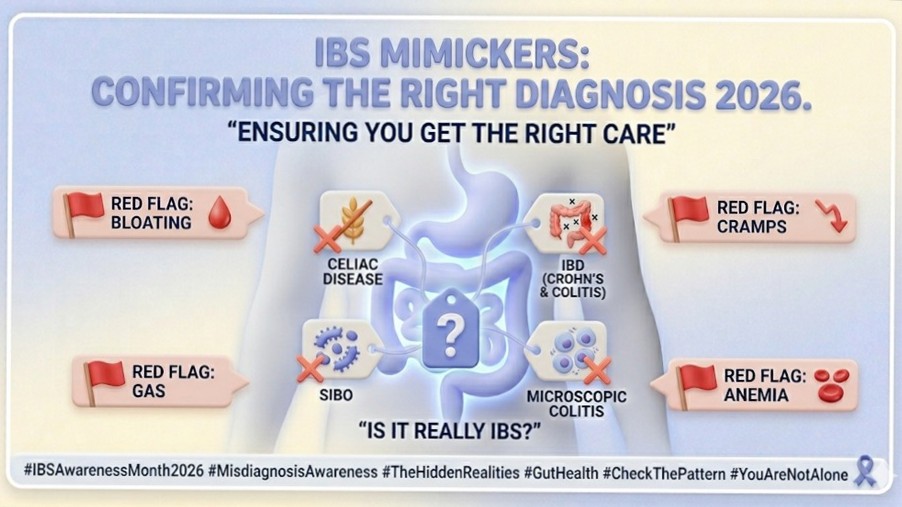
If your symptoms are persistent, severe, or change significantly, your gastroenterologist may investigate several other conditions before confirming IBS. Here are the most common "mimickers":
1. Celiac Disease
An autoimmune disorder triggered by gluten. Celiac disease damages the small intestine lining and can cause bloating, abdominal pain, diarrhoea, and constipation—the entire spectrum of IBS symptoms. Unlike IBS, untreated Celiac disease has serious, long-term health risks. A simple blood test is the first step, followed by Endoscopy.
2. Inflammatory Bowel Disease (IBD) – Crohn's & Colitis
Chronic inflammation of the digestive tract. Unlike the functional disturbance of IBS, IBD (Crohn’s disease and ulcerative colitis) causes actual damage. Key "red flag" symptoms that strongly point away from IBS toward IBD include:
• Blood in the stool
• Fever
• Unintentional weight loss
• Severe, localized abdominal pain
3. Small Intestinal Bacterial Overgrowth (SIBO)
A condition where excessive bacteria build up in the small intestine. SIBO causes significant bloating, gas, abdominal pain, and either diarrhoea or constipation, mirroring both IBS-D and IBS-C subtypes. SIBO can often be confirmed with a simple breath test.
4. Lactose Intolerance & Other Malabsorption Issues
When your body cannot properly digest certain sugars, like lactose (in dairy) or fructose (in some fruits/sweeteners), When these undigested sugars ferment in the gut, they pull in water, causing gas, pain, and watery diarrhoea. We can investigate this through dietary tracking and specific breath tests.
5. Microscopic Colitis
Inflammation of the colon that is only detectable with a microscope. The primary symptom is chronic, watery, non-bloody diarrhoea, which can appear identical to severe IBS-D. This requires a colonoscopy with biopsies for confirmation.
6. Endometriosis
In women, the growth of uterine-like tissue outside the uterus. While not strictly a digestive condition, endometriosis often affects the bowel surface, leading to cyclic abdominal pain, bloating, and diarrhoea/constipation that worsens significantly during menstruation.
💡 When to Talk to Your Gastroenterologist immediately
You should seek medical evaluation if you have "red flag" symptoms that are atypical for standard IBS:
• Unexplained weight loss
• Blood in your stool (visible or detected)
• Fever
• Pain that wakes you up at night
• Anaemia (low iron)
• New or worsening symptoms, especially after age 50
A correct diagnosis is the foundation of effective management. Every gut is a unique roadmap. We will work together to ensure we identify the true hidden realities of your symptoms. Let's find your unique balance.
When you're dealing with consistent digestive distress, a diagnosis of irritable bowel syndrome (IBS) might feel like an answer. However, IBS is often a diagnosis of exclusion—meaning other, sometimes more serious conditions must be ruled out first. Many diseases can produce symptoms that mirror IBS so closely that misdiagnosis is common.
This April, as part of IBS Awareness Month 2026, we are highlighting "The Mimickers"—conditions that can disguise themselves as IBS. It’s vital to ensure you are receiving the right diagnosis for the right treatment.
The Great Pretenders: Diseases That Mimic IBS
If your symptoms are persistent, severe, or change significantly, your gastroenterologist may investigate several other conditions before confirming IBS. Here are the most common "mimickers":
1. Celiac Disease
An autoimmune disorder triggered by gluten. Celiac disease damages the small intestine lining and can cause bloating, abdominal pain, diarrhoea, and constipation—the entire spectrum of IBS symptoms. Unlike IBS, untreated Celiac disease has serious, long-term health risks. A simple blood test is the first step, followed by Endoscopy.
2. Inflammatory Bowel Disease (IBD) – Crohn's & Colitis
Chronic inflammation of the digestive tract. Unlike the functional disturbance of IBS, IBD (Crohn’s disease and ulcerative colitis) causes actual damage. Key "red flag" symptoms that strongly point away from IBS toward IBD include:
• Blood in the stool
• Fever
• Unintentional weight loss
• Severe, localized abdominal pain
3. Small Intestinal Bacterial Overgrowth (SIBO)
A condition where excessive bacteria build up in the small intestine. SIBO causes significant bloating, gas, abdominal pain, and either diarrhoea or constipation, mirroring both IBS-D and IBS-C subtypes. SIBO can often be confirmed with a simple breath test.
4. Lactose Intolerance & Other Malabsorption Issues
When your body cannot properly digest certain sugars, like lactose (in dairy) or fructose (in some fruits/sweeteners), When these undigested sugars ferment in the gut, they pull in water, causing gas, pain, and watery diarrhoea. We can investigate this through dietary tracking and specific breath tests.
5. Microscopic Colitis
Inflammation of the colon that is only detectable with a microscope. The primary symptom is chronic, watery, non-bloody diarrhoea, which can appear identical to severe IBS-D. This requires a colonoscopy with biopsies for confirmation.
6. Endometriosis
In women, the growth of uterine-like tissue outside the uterus. While not strictly a digestive condition, endometriosis often affects the bowel surface, leading to cyclic abdominal pain, bloating, and diarrhoea/constipation that worsens significantly during menstruation.
💡 When to Talk to Your Gastroenterologist immediately
You should seek medical evaluation if you have "red flag" symptoms that are atypical for standard IBS:
• Unexplained weight loss
• Blood in your stool (visible or detected)
• Fever
• Pain that wakes you up at night
• Anaemia (low iron)
• New or worsening symptoms, especially after age 50
A correct diagnosis is the foundation of effective management. Every gut is a unique roadmap. We will work together to ensure we identify the true hidden realities of your symptoms. Let's find your unique balance.