Upper abdominal discomfort—burning, bloating, early fullness, or nausea—is one of the most common reasons patients visit a clinic. It is also one of the trickiest to diagnose.
While many assume every episode of burning or fullness stems from simple acid reflux, the reality is a complex overlap between Gastroesophageal Reflux Disease (GERD), Functional Dyspepsia, and Gastroparesis.
Whether you are a patient trying to understand your symptoms or a primary care clinician mapping out a diagnostic plan, here is a clear breakdown of how these conditions differ, when to use acid-blocking medications, and when an endoscopy is necessary.
Patient Guide: Understanding Your Symptoms
If you experience recurrent upper belly discomfort, understanding what your body is trying to tell you helps guide your conversation with your doctor:
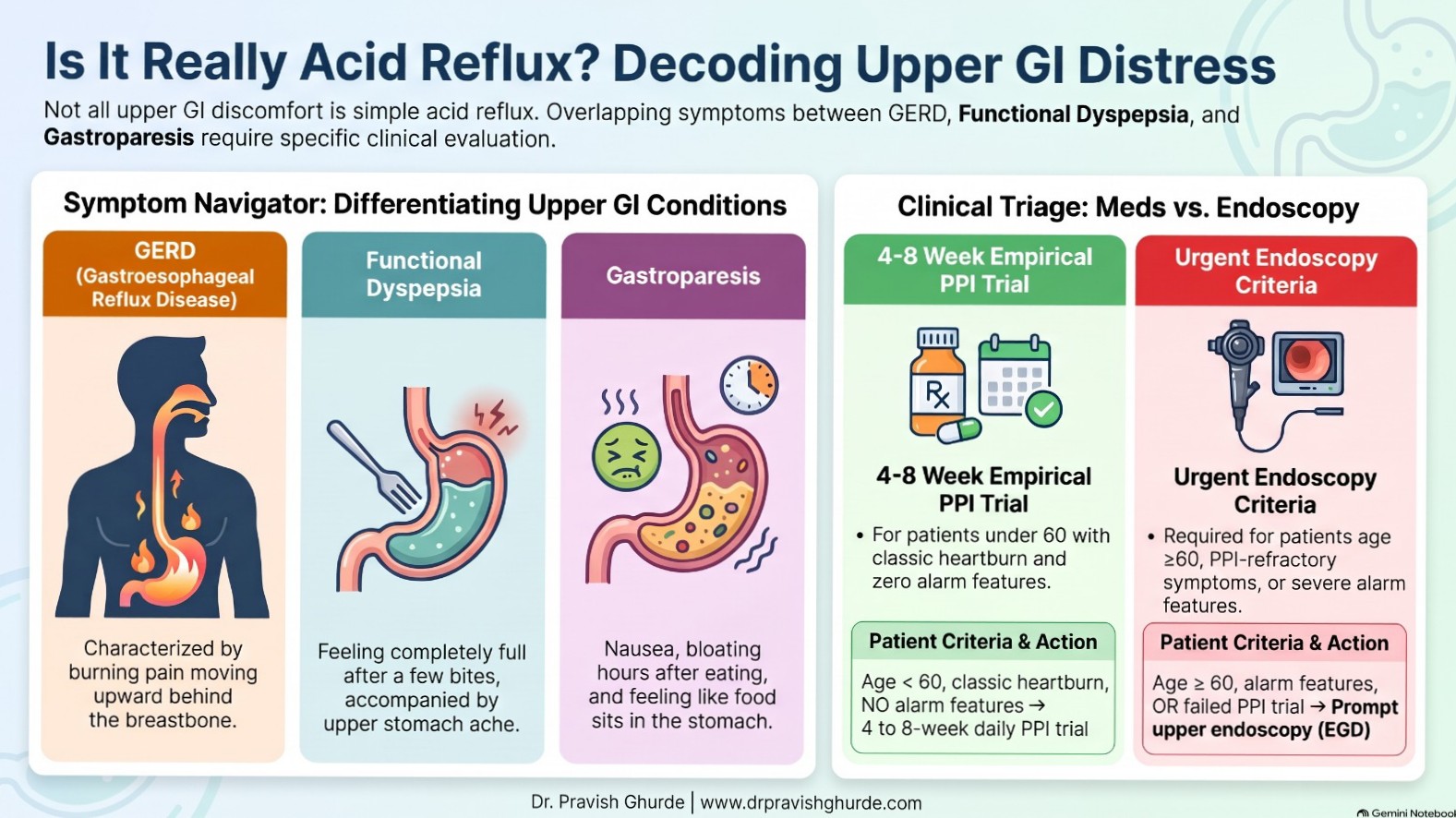
1. Is it mostly burning moving upward behind your breastbone?
This points toward GERD.
2. Do you feel completely stuffed after eating just a few bites, accompanied by an uncomfortable upper stomach ache?
This aligns with Dyspepsia.
3. Do you feel nauseous and bloated hours after eating, or feel like your food is just sitting in your stomach?
This raises suspicion for Gastroparesis.
Clinician Guide: Triaging & When to Order an Endoscopy
For primary care physicians, managing patients who cycle through standard-dose PPIs with zero relief requires a structured triage path:
1. When to Use an Empirical PPI Trial
a. Patients under age 60 presenting with classic, uncomplicated heartburn and regurgitation, with zero alarm features.
b. Trial a standard-dose PPI once daily for 4 to 8 weeks.
c. If symptoms recur immediately upon stopping or fail to improve after 8 weeks, avoid endless refills. Re-evaluate the underlying cause
.
2. When to Order an Urgent Upper GI Endoscopy (EGD)
An upper endoscopy is the gold standard for ruling out structural issues, ulcers, and malignancies. Order an EGD promptly if a patient presents with:
a. Age more than 60 years with new-onset upper GI symptoms.
b. Alarm Symptoms: Progressive difficulty swallowing (dysphagia), painful swallowing (odynophagia), unexplained iron-deficiency anaemia, persistent vomiting, a palpable abdominal mass, or unintentional weight loss (More than 10% body weight).
c. Refractory Cases: Symptoms failing to respond to a standard course of acid suppression.
d. Family History: First-degree relative with upper gastrointestinal cancer.
Bridging Care and Advanced Management
Navigating chronic, overlapping upper GI symptoms or investigating motility disorders often requires specialized diagnostics—such as high-resolution manometry or gastric emptying studies—alongside expert endoscopic evaluation.
If you are a patient seeking specialized care, or a clinician looking to refer a patient for advanced diagnostic workup, connect with us directly through www.drpravishghurde.com.
Keywords